

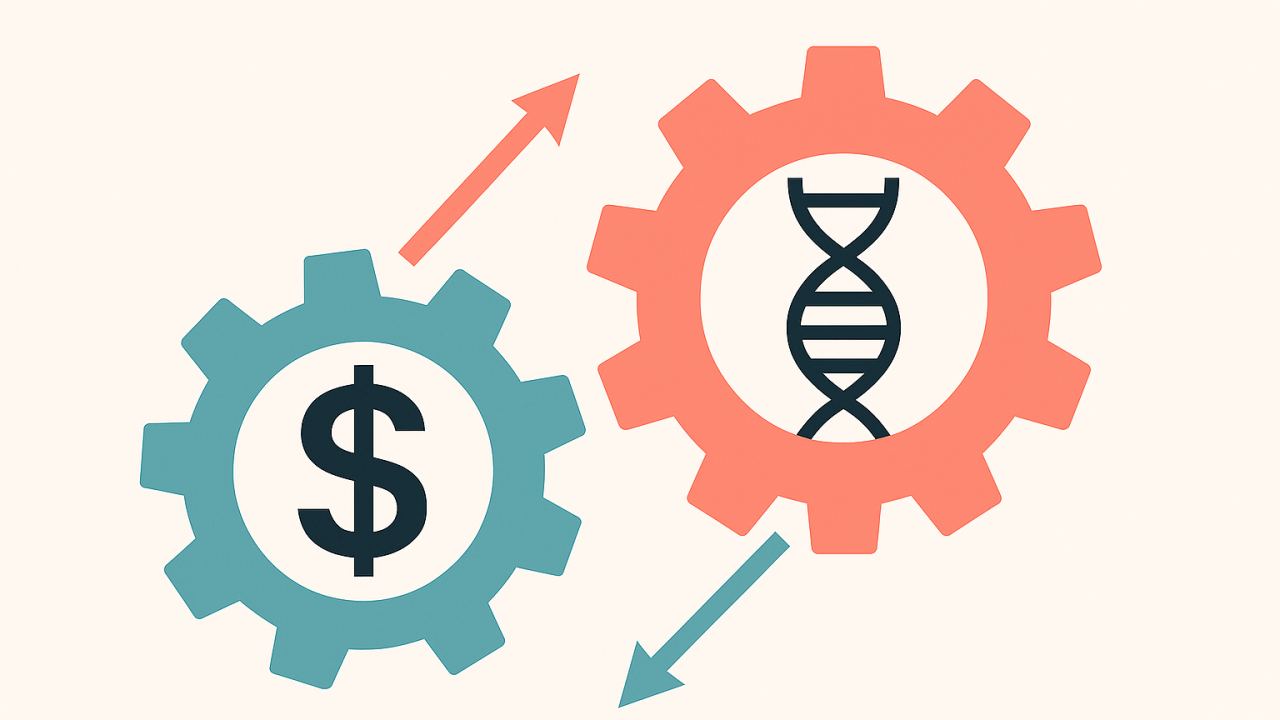
Biotech is often described as capital intensive, high risk, and slow to mature. Those statements are all true, but they are also incomplete. What we are seeing now is not simply the consequence of a difficult sector. It is the result of a deeper misalignment between the nature of scientific discovery and the way we choose to fund it.
Over time, I have come to believe that biotech does not suffer from a shortage of capital. It suffers from a model that misreads what the work requires.
We continue to apply an investment framework shaped by speed, comparability, and predictability to an industry defined by none of those things. In doing so, we create a quiet tension. Companies learn to speak in timelines they cannot truly control. Investors look for signals that do not appear on the schedule they expect. And somewhere in between, early-stage science, arguably the most important part of the system, struggles to find consistent support.
This is not a failure of intent. It is a failure of perspective.
Biotech does not move slowly because it is inefficient. It moves slowly because biology is complex, and understanding takes time. Progress is not linear. It unfolds in layers, often revealing as much through uncertainty as it does through confirmation. Yet the model surrounding it still treats value as something that should emerge quickly, cleanly, and in clearly defined steps.
That assumption begins to shape behavior. Capital gradually migrates toward later stages where uncertainty is reduced and timelines appear more legible. Earlier work becomes harder to fund, not because it lacks importance, but because it refuses to compress into familiar patterns. In response, companies adjust. They simplify the narrative, compress the risk, and frame progress in ways that are easier to consume, even when they are less reflective of reality.
Over time, this becomes less about individual decisions and more about the system itself. We begin to measure success too narrowly, often collapsing years of work into a single outcome.
But anyone who has spent time in biotech knows that value rarely arrives as a binary event. It accumulates. A target becomes clearer. A mechanism begins to resolve. A dataset opens pathways that were not visible at the outset. Even when a program does not reach its original endpoint, it often leaves behind insight that informs what comes next. That progression is not incidental. It is the core of how innovation in this field works.
Other sectors have found ways to accommodate this. In energy and infrastructure, capital is deployed with the expectation that assets take time to mature and that value deepens as uncertainty is reduced. In film and media, success is managed across a portfolio, not defined by a single outcome. In consumer industries, pipelines evolve, iterate, and build toward longer-term positioning. These models are not directly transferable, but they share something biotech has not yet fully adopted: a more expansive understanding of how value forms over time.
Biotech, by contrast, continues to operate within a narrower frame. It tends to reward the moment of certainty more than the process that makes that certainty possible.
If we are serious about strengthening the future of this sector, that is where the shift needs to occur, not simply in the amount of capital available, but in how that capital interprets what it is supporting.
This does not require abandoning discipline or lowering expectations. It requires changing what we recognize as progress. Scientific advancement can be articulated far more clearly than it often is. The strength of a biological hypothesis, the reproducibility of data, the expanding potential of a platform, these are not abstract ideas. They are early indicators of future value, even if they do not align neatly with traditional financial timelines.
At the same time, biotech itself has a role to play in this shift. Communication between science and capital has too often been shaped by translation rather than alignment. Risk is softened. Timelines are framed optimistically. Uncertainty is implied rather than explored. That may make individual moments easier, but it does little to build long-term trust.
A more transparent dialogue would not deter capital. It would allow for a different kind of engagement. Investors do not require certainty. They require clarity. They need to understand how risk evolves, how value is being built, and where inflection points truly exist.
And that leads to a broader question, particularly as conversations begin to take shape around national strategy and long-term competitiveness, including through efforts like American Biotech Innovation Alliance (ABIA).
The question is no longer simply how to attract more capital into biotech, it is, “what kind of capital biotech is designed to support?”
If we continue to apply a model built for speed, we will continue to see distortion, compressed expectations, misaligned incentives, and underinvestment in the earliest stages of real innovation.
If, however, we allow for a model that reflects how science unfolds, iterative, uncertain, and cumulative, we create the conditions for something far more durable.
The capital is not missing. The science is not missing.
What has been missing is a shared understanding of time, of progress, and of what value really looks like before it becomes obvious.
That is not a structural problem alone. It is a conceptual one.
And it is one we now have an opportunity to rethink.
Investors, I would be very interested to hear your thoughts? What needs to change to re-invigorate early innovative funding?