
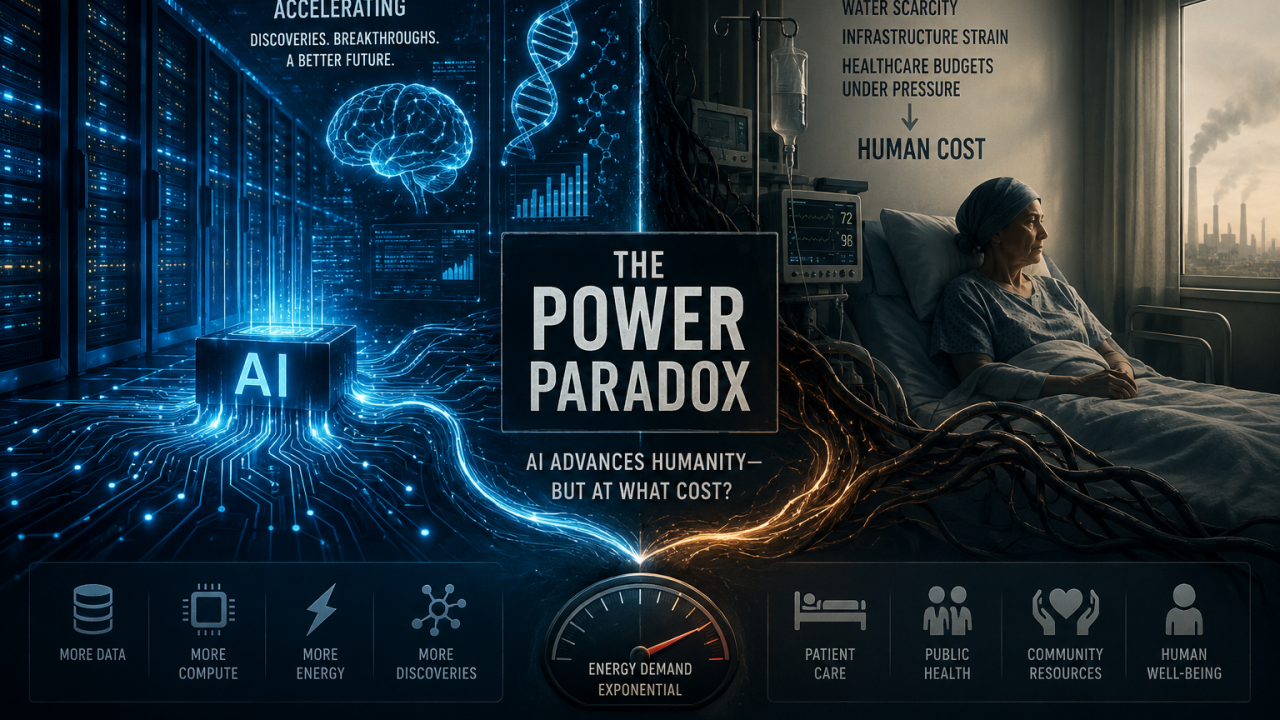
Disclaimer: Shamelessly leveraged ChatGPT to generate the image to share the power paradox that I raise in the article
I have sat in rooms where brilliant people could not find the slide.
You know the moment. Someone asks a question that should be answerable, a decision made two years ago, a trial result from a compound that looked similar, a regulatory interaction that taught the team something important, and the room goes quiet. Not because the knowledge does not exist. It does. It lives in a deck someone built late on a Tuesday in 2021, in notes from a meeting that was summarized but never properly filed, in the memory of a colleague who has since moved on.
The friction of finding it is not just inefficient. In biotech, it costs lives. Not dramatically, not in any single moment you can point to, but cumulatively, in the months added to timelines, in decisions made without full context, in assets abandoned because a team could not quickly enough build the case to keep going.
We are at an inflection point. The tools to fix this are no longer theoretical.
What AI Actually Does: Concretely
Let me be precise, because the industry has suffered through enough AI hype to be rightfully skeptical.
When Bristol-Myers Squibb announced its enterprise-wide strategic agreement with Anthropic, deploying Claude as a shared intelligence platform across more than 30,000 employees, the language they used was not about chatbots or search. It was about agentic capability: an AI connected to thousands of internal data sources that can generate a clinical study report from underlying trial data, surface the right scientific context from decades of internal research, or trace the root cause of a manufacturing deviation in real time.
That is a different category of tool. Not a better search engine. A reasoning layer that synthesizes across the entirety of what an organization knows.
Think about what that means in practice. When Sanofi acquired Genzyme, what happened to the knowledge? Years of insights, FDA interaction notes, regulatory strategy decks, clinical lessons learned, and the hard-won understanding of a rare disease community built over a decade, all lived on individual laptops rather than any shared system. When the Genzyme team departed during the transition, that knowledge went with them. The Sanofi team had no idea it even existed. There was nothing to search, nothing to retrieve, nothing to hand off. It was simply gone.
This is not a Sanofi problem or a Genzyme problem. It is an industry problem that plays out in every acquisition, every restructuring, every wave of attrition. We lose institutional memory the way we lose water through a cracked pipe: steadily, invisibly, and at enormous cost.
AI changes this equation, but only if we change our behavior first. When an organization’s knowledge lives in connected, accessible systems rather than on individual laptops, an AI layer can activate it: surfacing the right scientific context, reconstructing the rationale behind decisions, connecting a current challenge to a past lesson the current team never knew existed. The technology is ready. The organizational discipline to feed it is the work.
The human role does not disappear. It elevates. Experts stop being archaeologists and start being architects. Their energy goes to what only humans can do: bringing judgment to ambiguous situations, reading the room in a health authority meeting, knowing which data point will matter to this reviewer at this agency in this therapeutic area, because they have been in those rooms before and no document fully captures what they learned.
I saw this play out at an emerging biotech working on a complex rare disease program. We convened experienced clinical and regulatory experts, people who had collectively spent decades in FDA interactions, and asked them to pressure-test the regulatory strategy. What happened in that room could not have been generated from a literature review or database search. People shared specific insights from specific meetings: what a division director had said about a particular endpoint, how a prior advisory committee had reacted to a similar benefit-risk argument, where a previous sponsor had made a misstep that cost eighteen months. Those insights, unwritten, experiential, and earned, evolved the plan in ways a team without that history simply could not have achieved. The FDA supported the strategy. The program moved forward.
That is what AI, given access to the right institutional content, can help preserve and democratize. Not replace the experts, but convene them more effectively, prepare teams more thoroughly, and ensure the hard-won lessons of one generation of drug developers remain available to the next.
The time is now. Not next year. Now.
The Companies Who Cannot Wait
The uncomfortable truth about biotech innovation is that most of it does not happen at companies with 30,000 employees.
It happens in companies with 30 people, or 300, carrying a single asset through a development process that is brutally expensive, unforgiving of inefficiency, and designed around the assumption that the submitter has unlimited resources.
Consider one of the least-discussed ways programs fail, one I have watched derail more times than I care to count: validation batches and product expiry. To bring a drug to market, companies must run validation batches, expensive manufacturing runs that establish a product’s stability and shelf life. For many emerging biotechs in oncology, the cost of running those batches early is prohibitive. So, they wait until the clinical program has derisked the spend. And while they wait, the clock runs on whatever stability data they have.
The consequence is concrete. The FDA will not be liberal with expiry dating, and rightly so. But when a product reaches the market with less than twelve months of remaining shelf life, it becomes nearly impossible to contract with some GPOs, the group purchasing organizations that control formulary access for hospital systems. The product that took a decade and hundreds of millions of dollars to develop sits on the wrong side of a procurement threshold because a small company could not afford to run a batch at the right moment.
This is where AI-enabled evidence synthesis has regulatory implications beyond efficiency. If an AI system can present a coherent, auditable, continuously updated evidence dossier, drawing from pre-clinical through every available clinical data point, it creates the foundation for a different kind of regulatory conversation. Not a lower standard. A more legible standard. One where a small company with strong but incomplete evidence can engage in a rolling dialogue with regulators rather than a single high-stakes submission at the end of a resource-depleting process.
As a founding member and strategic advisor to the American Biotech Innovation Alliance (ABIA) , I believe this is precisely the policy innovation the ABIA’s national strategy for biotech should be advancing. The ABIA exists because the United States biotech ecosystem, particularly its emerging and mid-size companies, is a strategic national asset that requires intentional policy support, not just market forces. AI-enabled regulatory pathways are one of the most concrete near-term opportunities to act on that mission. The framework does not exist yet. That means we have the chance to help build it.
The Uncomfortable Truth About the Fuel
Now for something that complicates everything above, because no honest conversation about AI can avoid it.
The compute required to power these systems is staggering, and it is growing faster than our energy infrastructure can responsibly support.
Look at the latest forecast from ERCOT, the grid operator for Texas. Their 2030 load projection could max out at 319,650 megawatts, a number that would drop to 107,000 megawatts if large and medium data center loads were excluded. That gap, more than 200,000 megawatts driven primarily by AI infrastructure, represents a scale of demand we have simply never seen.
Peter Kelly-Detwiler‘s work reporting on the Compute Heat Rate (CHR), building on analysis by industry veteran Hans Royal, explains why this demand will not self-correct the way traditional industrial loads do. Historically, large energy consumers like steel mills and aluminum smelters act as a natural market mechanism, curtailing when wholesale electricity prices hit $40 to $120 per megawatt hour. AI data centers do not work that way. The economic value generated per megawatt hour of compute is so extraordinary that Royal estimates a blended CHR of roughly $6,350 per megawatt hour, meaning these systems are unlikely to curtail power usage until electricity prices reach roughly 127 times the current wholesale average.
The implication is direct: AI loads will not curtail at any price level currently observed in US wholesale markets. As new hardware generations emerge, where a refrigerator-sized system draws the peak power equivalent of roughly 65 households, we face step changes in consumption that require step changes in energy policy. Everyday consumers, families, hospitals, clinics, the very patients we are trying to reach with better medicines, may find themselves competing for grid capacity with infrastructure that will outbid them at virtually any price.
I am not an energy expert, and I want to be appropriately humble here. But I will say this plainly: nuclear energy may be one of the few genuinely clean paths to meeting the compute requirements of the AI revolution at the scale that is coming. Reliable, high-density, low-carbon baseload power is exactly what data centers need, and exactly what intermittent renewables alone cannot reliably provide. The policy and public perception challenges are real, but so is the alternative: a future where the data centers powering AI innovation draw from grids that cannot keep up, driving up costs for everyone, and ultimately threatening the stability of the very communities, healthcare systems, and planet we are working to serve.
The irony would be brutal: AI accelerates medicine to patients faster, but the energy cost of running AI destabilizes the infrastructure those patients depend on. That is a Sisyphean trap we must name before we walk into it.
The ABIA’s national strategy for biotech is incomplete without a serious energy chapter, one that asks: what does the energy infrastructure of a thriving, AI-enabled biotech ecosystem require? What is the federal role in ensuring that compute access is equitable, not just available to companies large enough to build their own data centers? How do we ensure that the patients and families whose lives we are trying to improve are not being priced out of the grid that keeps their lights on?
These are not peripheral questions. They are central to whether this inflection point takes us somewhere we want to go.
What We Do Now
Let me end where I started: in the room where brilliant people cannot find the slide.
The way out of that room is available today. Companies like BMS are demonstrating at scale that connecting AI to institutional knowledge produces something genuinely useful. Not a toy. Not a demo. A working layer of organizational intelligence that makes every expert more effective and ensures that what was learned in 2019 remains accessible in 2029, even if everyone who learned it has moved on.
For emerging biotech, the entry point is lower than you might think. You do not need 30,000 employees to benefit. You need clarity about what knowledge your organization holds, the discipline to put it somewhere accessible rather than on a laptop, and the governance to do it responsibly.
For the industry at large, the regulatory conversation cannot wait for a perfect framework to emerge on its own. Scientists and operators who understand both the biology and the technology need to lead it, within companies, through organizations like the ABIA, and in direct engagement with health authorities working to evaluate AI-synthesized evidence responsibly.
And for everyone building, funding, or advocating for biotech innovation: the energy question is yours too. The compute that powers the AI revolution is not a utility that will simply provision itself. It requires a biotech community willing to be at the energy policy table, not just the health policy table.
We are at the inflection point. The question is not whether AI will reshape how medicines are discovered, developed, and delivered to patients. It will. The question is whether we are intentional enough, as companies and as an industry, to shape that reshaping. To build the regulatory frameworks, the institutional habits, and the energy infrastructure that allow the full ecosystem of innovation to benefit, not just the largest players.
The slide is findable. Let us go find it. And then let us make sure the lights stay on.
As a founding member and strategic advisor to the American Biotech Innovation Alliance, I am actively engaged in the national strategy work referenced here. I welcome conversation in the comments, particularly from those working at the intersection of AI, regulatory strategy, and biotech policy.